

ISLAMIST RADICALISM IN PAKISTAN
- alzebindia
- Oct 5, 2021
- 7 min read

While religious radicalism in Pakistan is strongly associated with General Zia, and is often believed to be a remnant of the Cold War decision to support the Afghan Mujahideen resisting the Soviet Union’s conquest and occupation of their country, its origins date back further.
Pakistan is a unique country. It was carved out of independent India as a homeland for India’s Muslims. Thus, it became the first modern Islamic republic in the world, a country whose very nature was religious and whose raison d’etre was Islam. Pakistan was driven to do this partly by default, as a way to define itself as against India, a project always made more difficult by the fact since more Muslims have always lived in the secular Indian Union than in Pakistan. As some scholars have pointed out, one reason why Pakistan as a state has always been so troubled is that it was the backup option; the concept was not initially imagined as a literal partition and Islamic state.

THE “ENABLING ENVIRONMENT” FOR RADICALIZATION
Violent terrorist attacks are not the product of a single actor operating in isolation, but are instead embedded in a larger social and political milieu. Indeed, violent radicalization can be represented as a pyramid, with the active terrorist at the top, the religious-political organizations in the middle and the missionary Islamic organizations at the bottom. Linkages between these three levels create an “enabling environment” that enhance the means and opportunities to advance an Islamic identity-based social movement and, in effect, the radicalization of youth to potentially militant causes.
By 1949, Pakistan had adopted legislation that began the path to discriminating against minority religious communities. A major factor for Pakistan’s definition of itself as an Islamic state was described by its first Prime Minister Liaqat Ali Khan, who acknowledged that “the land upon which the new Pakistani state stood was inextricably linked to earlier Muslim invasions of South Asia”. In 1953, for instance, anti-Ahmadi riots erupted across Pakistan. This led to the imposition of martial law for the first time. The riots were spearheaded by the Jamaat-e-Islami (JeM), which was able to use socialist-derived class grievance narratives, as well as religious sectarianism, to mobilise the crowds since the Ahmadi community, though small, was rich and influential.
In 1956, the Pakistani constitution established Pakistan as an Islamic, yet democratic, state. The Islamist project was supported by revivalist organizations like the powerful JeM, as it advocated for an “Islamistan” that united all Muslims and the countries between Pakistan and Turkey into a single, united polity. It was under Zulfikar Ali Bhutto’s socialist Pakistan People’s Party that the laws were instituted disenfranchising Pakistan’s non-Muslims, specifically ruling that Ahmadis were not Muslim. It was at this point the government promulgated the Hudood Ordinances that gave the fixed penalties of Islamic law legal force in Pakistan. The Shariat Bill, to make Pakistan governed by the shari’a rather than civil laws, was introduced into the Pakistani Senate in 1986, and activated in 1991 under Nawaz Sharif’s Pakistan Muslim League government. With this new wealth, one of General Zia’s first acts was to establish the Army of the Companions (Sipah-e-Sahiba), which specifically targeted Shi’is. Thus began a new phase of the Islamization of Pakistan, what can be called the “Sunni-ization”, bringing a sectarian edge to the rising religious radicalism. The spread of the narrow Wahhabi-Salafi brand of Sunni Islam, demanding citizens adhere to the “correct” Islam and agitating against non-Islamic populations, correlated with a spike in sectarian violence. The number of radical and militant groups proliferated.
Around 600 Shi’is were killed between 1999 and 2003 as a result of extremist violence. These radical groups were encouraged and sometimes even armed by the Pakistani army and its intelligence agency, the Inter-Services Intelligence (ISI). The metastasis of the problems around the militants has spilled over to the blasphemy law. According to the data of Pakistan’s National Commission for Justice and Peace, a total of 776 Muslims, 505 Ahmadis, 229 Christians, and 30 Hindus have been accused under various clauses of the blasphemy law between 1987 and 2018. There are other measures of Pakistan’s slide into religious intolerance. Forced conversions and abductions of Hindu women have become widespread. According to the 2017 Human Rights Commission of Pakistan report, over 1,000 non-Muslim girls are forcibly converted to Islam every year. This is having the predictable effect of driving Hindus out of Pakistan: an average of 5,000 Hindus migrate from Pakistan to India each year. Minorities, which represented around a fifth of Pakistan’s population at its founding, have shrunk to just four percent.
ATTACKS ON TEMPLES
On September 15th 2020, the tiny Hindu community in Ghotki in Pakistan’s Sindh province was terrorized. It began with the arrest of a Hindu school principal, Notan Mal, on charges of blasphemy. The principal was first attacked by a mob and a temple was vandalized. Soon riots broke out in Sindh. The charges against Mal were based on the complaints of Abdul Aziz Rajput, a student’s father, who claimed that the teacher had committed blasphemy by uttering derogatory remarks against the Prophet of Islam. Ghotki was shut down.
The blasphemy law in Pakistan is at the heart of the religious radicalism and oppression of minorities in the country. The blasphemy law was adopted in Pakistan during the rule of then-President, former General, Muhammad Zia-ul-Haq, as part of his decision to accelerate the Islamization of the country. In 1982, life imprisonment was prescribed for “willful” desecration of the Qur’an, and in 1986, penalty for blasphemy against the Prophet Muhammad was recommended to be “death, or imprisonment for life”. The law has since been used with impunity against minorities like the Ahmadiyya and Christians.
According to the survey, there were 428 Hindu temples in Pakistan at the times of partition and 408 of them were now turned into toy stories, restaurant, govt offices and schools. In the aftermath of the Babri Masjid demolition Pakistani hindus faced riots and mobs attacked 5 hindu temples in Karachi and set to fire 25 temples in towns across the province of Sindh.
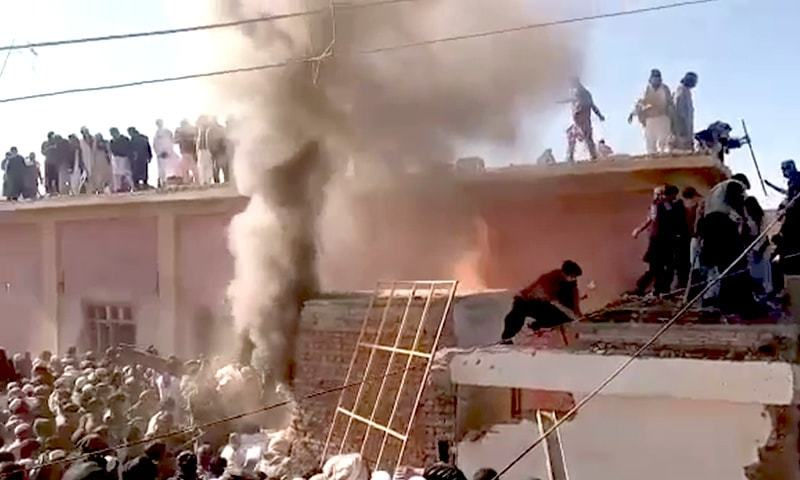
Recently a mob vandalised the samadhi (shrine) of a Hindu saint and subsequently set it on fire in the Karak district of Khyber Pakhtunkhwa on 31 Dec 2020. The incident took place in a far-flung area of Karak's Teri town, with police saying law enforcement personnel dispersed the mob after the violence.
"More than a thousand people led by some local elders of a religious party held a protest and demanded the removal of the Hindu place" of worship” the mob that was chanting slogans set the shrine on fire before demolishing it as well as an under-construction house owned by a member of the Hindu community.
SIGNATURES OF RADICALISATION
The centre of gravity is shifting from groups to individuals; the number of people who now support the radicals and propagate an anti-American line is significant. It may be far more difficult to counter this trend that is fuelling Islamic terrorism than it is generally assumed. As a recent study of violent extremism among Pakistanis suggests, the battle of ideas is being lost rapidly and providing an even playing field for moderate leaders and opinion makers is becoming more and more difficult. Violence and extremism perpetrated in the name of religious ideology is now directly linked with the American led war in Afghanistan and the Pakistan army crackdown in Waziristan and other parts of the western frontier.
Taliban militants have taken control of many parts of Peshawar; several suicide attacks have taken place here; visitors need police escorts, schools for women have been closed, video and music shops have been destroyed and barbers who dare shave beards are punished. A public morality law is being considered that will give mullahs power to prosecute anyone who does not follow the ban on dance and music.
INTERNATIONAL LINKAGES
The radical Islamic movement in Pakistan is connected with the global jihadi movement and is not a local phenomenon. Regardless of geo-political realities, its immediate aim is to establish a revolutionary Islamic regime in Pakistan. It is essentially a jihadi response to counter American policies and military activities in Pakistan, Afghanistan and other parts of the world in the last few years. The Islamic movements have grown rapidly in those countries where Americans have major strategic stakes. In Egypt, Algeria, Iran, Turkey, Pakistan and parts of West Asia they have found mass support.
GROWTH OF ISLAMISM IN THE PAKISTAN ARMY
Islamization of the Pakistan Army is of significant concern to the National Security of India. Islamization of the Pakistan Army has been occurring in some form since its birth in 1947. The nation was founded on the unity of a common religion. This religious identity was ingrained in the Army as a way of distinguishing itself from its Hindu counterpart. Military organization and structure was left unaffected through the first 30 years of its existence, despite the Army’s reliance on Islamists and Militant Islam to affect both foreign and domestic issues. Starting with the First Indo-Pakistan War in 1947, the Pakistan Army used Militant Islamists as a weapon against the Indian military. The Army used Islamist rhetoric to mobilize Pashtun tribesmen from the Federally Administered Tribal Areas (FATA) and urged clerics to issue fatwas ordering their clans into Kashmir. One of the Pakistan Army’s brigadier generals had noted that the Army’s leading officers often sounded like ‘high priests rather than soldiers’.

In addition to the changes affecting the atmosphere in the military, soldiers were recruited from a society that was simultaneously being impregnated with Deobandi madrassas that sprung up on virtually every street corner. The common Pakistani and soldier saw these fighters and their ideology as protector of the state, and more important, of Islam.
However, Zia’s Islamisation policies brought in a new breed of officers and men who wanted to pursue an active Islamic agenda in military matters. Not only proselytization activities of the Deobandi/Wahabi dispensation were allowed in the barracks, even active personnel were allowed to go for activities such as Tabligh. A new breed of military thinkers and strategicians also emerged who began to propound a merger of social jihadism with military plans.
VIEWPOINT
● Pakistan is a failing state that may collapse after a bitter internal war but it will still remain the epicentre of the global jihadi movement and the principal breeding ground of Islamic radicalism.
● Taliban, al Qaeda and their supporters now have a large armed following, secured bases and sanctuaries in the tribal areas of Pakistan, which they will continue to hold. Their domain is likely to remain confined to remote tribal belts for the present and their influence over the rest of the country will be limited.
● The political turmoil in Pakistan has created a dangerous and chaotic environment in which the influence and following of the radical groups has increased greatly. They have support bases in mainland Pakistan as is apparent from suicide attacks that have been launched by them in several parts of Pakistan


Comments